



Changing Denmark
After Billund: Where next? New figures show a significant increase in the proportion of non-Danish citizens – outside the capital
The emergence of the Billund International Citizens' List has sparked attention and interest – including among us at Fair & Fornuftig. For us, it raises a bigger question: Where could the next Billund arise – and what is driving this mobilization?
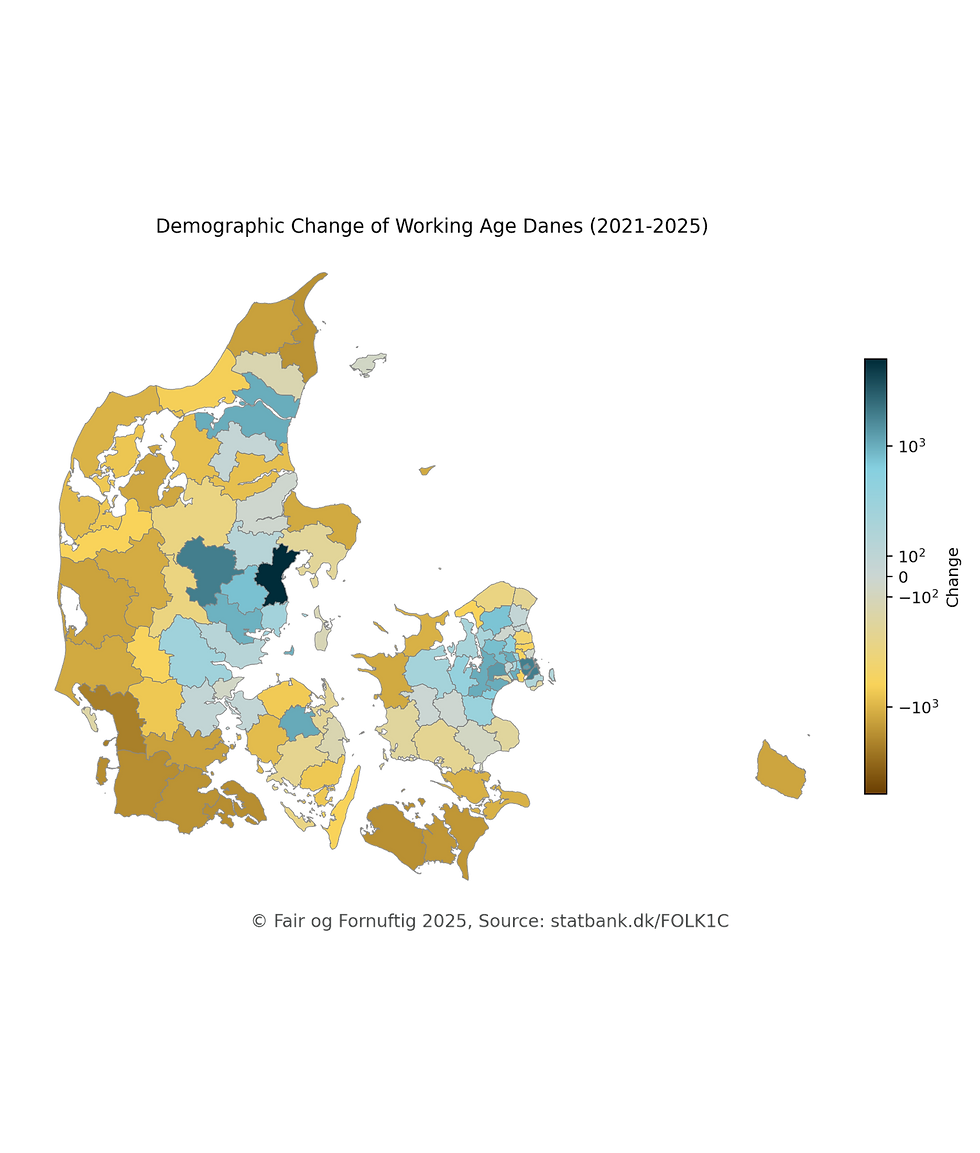
Based on open population data, Kelly Draper Rasmussen, treasurer of Fair & Fornuftig, has prepared a new analysis of the development in the proportion of residents without Danish citizenship across the country's municipalities.
More than half a million people in Denmark today have a foreign background – a group that is rarely mentioned as part of the Danish reality, but which increasingly influences both the labor market, schools and local communities.
The new figures paint a picture of a changing demographic – not necessarily a voter group that can be “mobilized”, but a Denmark in transition, where large parts of the population have roots or relationships outside the country’s borders. It is a reality that calls for both recognition and updated policy.
“There is a lot of talk about foreign workers, but rarely with them,” says Kelly Draper Rasmussen. “The figures show that they are an integral part of Denmark’s infrastructure – on the factory floor, in schools and in associations. It is important that decision-makers see how many people actually contribute, even though they are rarely included in the political debate.”
The analysis reveals that it is not in Copenhagen, but in a number of smaller and medium-sized municipalities, that the proportion of residents without a Danish passport has increased most significantly in recent years. This applies, for example, to Vejen, Billund and Ringkøbing.
“The rhetoric has so far been exclusively skeptical, to say the least,” says Benjamin Schenkel, leader of Fair & Fornuftig. “We call for a respectful, nuanced and data-driven approach. It is positive to see increasing attention to this part of the population – to our desire and ability to contribute to Danish values, prosperity and the welfare society.
But we also hope for something a little deeper. We want local politicians to join us in telling the other side of the story – about the real status of immigration – and for the language in the national debate to become more subdued and reflective. When entire groups are made targets of generalizations, it does more harm than good. Our society needs conversation and cooperation, not mistrust.”
Fair & Fornuftig is a non-profit organization working for a new direction in immigration policy – based on concrete experiences and an understanding of the structural driving forces behind it. Now the organization is moving into the next phase: exploring how society can handle the changes with more insight and less fear.
The goal is to combat the fear of contact – the fear and prejudice that characterize the debate – and instead promote a culture where diversity is seen as a resource.
In the weeks leading up to the election, Fair & Fornuftig will publish several local analyses and visualizations that make the image of Denmark in change more accessible to both media, citizens and decision-makers.
CHANGE


